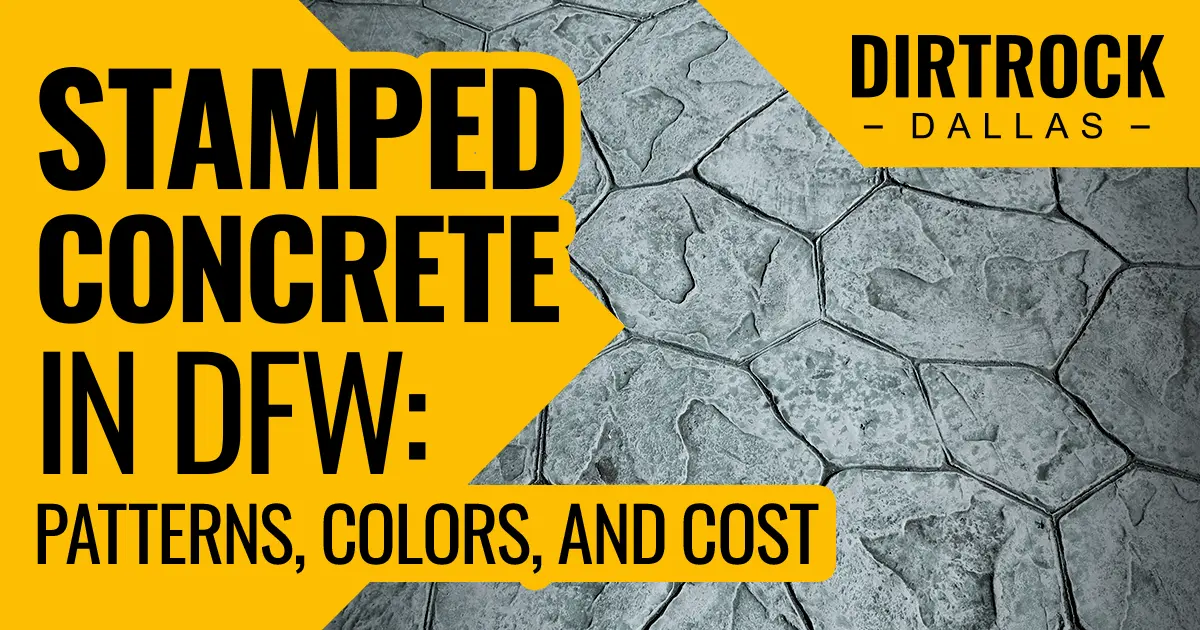
Most DFW homeowners pay $10 to $21 per square foot for stamped concrete, but the pattern, color, and what sits under the slab all change that number. Here is what to know before you get a quote.
What Is Stamped Concrete and How Does It Work?
Stamped concrete is regular concrete pressed with textured mats (called stamps) while the surface is still wet. The stamps leave behind patterns that mimic stone, brick, wood, or tile. Color gets added through integral pigments mixed into the concrete, color hardener broadcast onto the surface, or a combination of both.
The process moves fast. A crew pours the slab, broadcasts color hardener, applies a release agent (which prevents the stamps from sticking and adds a secondary tone), then presses the stamps into the surface before the concrete sets. Timing matters. Start stamping too early and the stamps sink. Start too late, and the pattern won’t take.
Once the concrete cures (typically 24 to 48 hours for foot traffic, 7 days before you drive on it), the crew washes the surface and applies a protective sealer. The result looks like real stone, tile, or pavers at a fraction of the cost.
You can stamp concrete on patios, driveways, pool decks, walkways, and steps. In North Texas, stamped patios and stamped concrete driveways are the two most common residential applications.
Stamped Concrete Patterns: Which One Fits Your Home?
Stamped concrete patterns fall into a few families. The right one depends on your home’s architecture, the surface you are covering, and how realistic you want the finished look.
Stone Patterns (Ashlar Slate, Roman Slate, Seamless Stone)
Ashlar slate is the most popular stamped concrete pattern in DFW and across the country. It features rectangular stone shapes arranged in a staggered grid. Clean geometry, natural stone texture, and it works with both modern and traditional homes.
Roman slate uses a similar rectangular layout but with a more pronounced, hand-chipped texture. The surface has deeper relief, which creates stronger shadow lines and a more rustic appearance. Roman slate works well on patios and pool decks where you want the look of flagstone without the uneven footing.
Seamless stone (also called texture skins) adds surface texture without visible joints or grout lines. The result resembles a natural rock face. Seamless patterns are popular on pool decks and large patios where a bold pattern would overwhelm the space. They also cost less to install because the stamps are faster to apply.
Wood, Brick, and Cobblestone Patterns
Wood plank stamps replicate the grain and texture of hardwood or barnwood planks. You get the warmth of wood on your patio or walkway without the rot, warping, or termite risk that comes with real wood in the Texas climate. Wood plank patterns are gaining popularity in 2026, especially for covered patios and outdoor living spaces.
Brick patterns (running bond, herringbone, basket weave) deliver a classic look. They work well on driveways and walkways where the repeating pattern adds visual movement. Brick-stamped concrete holds up better than actual brick pavers in North Texas clay soil because the slab moves as one piece rather than shifting brick by brick.
Cobblestone patterns create an old-world European look. The rounded, irregular stone shapes add character to entryways and courtyard patios. Cobblestone stamps require more labor (each stone impression is smaller, so there are more of them), which pushes the cost toward the mid-to-premium range.
Choosing Stamped Concrete Colors for Texas Heat
Color is half the design. A good pattern with the wrong color looks flat.
Stamped concrete color comes from two sources: a base color (integral pigment or color hardener) and an accent color (the release agent). The base gives the slab its primary tone. The release agent settles into the stamp’s low points and creates contrast that mimics the natural color variation you see in real stone.
Earth tones remain the most popular choice in DFW. Tan, sandstone, and terra cotta complement the brick and stone exteriors common across North Texas neighborhoods. These warm tones also hide dirt well between cleanings.
Gray and charcoal are gaining ground in 2026, especially on modern and contemporary homes. Cool-toned stamped concrete pairs well with metal, glass, and painted stucco exteriors.
A few color considerations specific to Texas:
- Darker colors absorb more heat. A charcoal stamped patio will be noticeably hotter underfoot on a July afternoon than a sandstone one. If the surface sits in direct sun and you plan to walk on it barefoot, lean toward lighter base colors.
- UV exposure fades unprotected color over time. A quality acrylic sealer blocks UV degradation and keeps the color looking fresh. Resealing every 2 to 3 years is the standard maintenance cycle.
- Multi-color applications (two or more base tones plus an accent release) add $1 to $3 per square foot but produce a more realistic finished look. The premium tier pays for itself on surfaces visible from the street or from indoor living areas.
How Much Does Stamped Concrete Cost in Dallas-Fort Worth?
Stamped concrete pricing in DFW depends on the finish tier, the size of the project, and whether the old surface needs to come out first.
Patio Pricing
DIRTROCK DALLAS prices residential concrete work across three tiers:
- Standard poured concrete (broom finish): $7 to $10 per square foot. Four-inch slab with rebar. No decorative finish.
- Stamped concrete (single color): $10 to $15 per square foot. One stamp pattern, one base color with a contrasting release agent. Four- to five-inch slab with rebar.
- Premium stamped concrete (multi-color): $15 to $21 per square foot. Multi-color application, six-inch slab, rebar reinforcement, and a double-seal finish coat.
For a 400-square-foot backyard stamped concrete patio (a common size in DFW), expect to pay roughly $4,000 to $6,000 at the single-color tier or $6,000 to $8,400 at the premium tier.
Driveway Pricing
Stamped concrete driveways follow the same per-square-foot tiers. The difference is total area. A standard two-car driveway in DFW runs about 600 square feet. At the single-color stamped tier, that puts the price between $6,000 and $9,000. Premium stamped driveways for the same area run $9,000 to $12,600.
Driveways also require a thicker slab (typically five to six inches) to handle vehicle weight, which nudges the per-square-foot cost toward the higher end of each range.
If your existing driveway needs demolition and removal first, that work is quoted separately based on square footage and haul distance. DIRTROCK DALLAS handles demo, hauling, subgrade prep, and the new pour as one project scope.
Note: Pricing does not include site preparation work beyond standard subgrade prep. Projects that require significant grading or excavation are quoted as separate line items.
Ready to see what your project costs? Get a free quote from DIRTROCK DALLAS. Tell us your square footage and finish tier, and we’ll get back to you with a number.
Stamped Concrete vs. Pavers: Cost and Durability Compared
Homeowners ask this question more than any other before choosing a surface material. The comparison breaks down across four factors in DFW.
Upfront cost: Stamped concrete runs $10 to $21 per square foot installed. Pavers run $25 to $50 per square foot installed. For a 400-square-foot patio, that difference can be $6,000 or more.
Lifespan: A properly installed stamped concrete slab lasts 25 to 30 years. Pavers can last 50 years or more with regular joint sand maintenance. The key qualifier is “properly installed.” On North Texas clay soil, a stamped slab poured on uncompacted ground will crack and settle within a few years regardless of the concrete mix.
Maintenance: Stamped concrete needs resealing every 2 to 3 years ($200 to $600 per treatment for a typical patio). Pavers need joint sand replenishment every 2 to 3 years and occasional weed control between joints.
Repairs: A cracked paver can be pulled out and replaced in 15 minutes. A cracked stamped concrete slab requires saw-cutting the damaged section and re-pouring, and color-matching a patch to aged concrete is difficult. This is one area where pavers hold a clear advantage.
Bottom line for DFW homeowners: Stamped concrete costs less upfront and delivers a comparable look. The durability gap narrows when the subgrade is prepped correctly (more on that next). If long-term repair simplicity matters more to you than initial savings, pavers are the stronger pick.
Why Subgrade Prep Determines How Long Your Stamped Concrete Lasts
A four-inch slab of properly mixed concrete is only as good as the ground it sits on.
North Texas clay soil expands when it absorbs moisture and contracts during drought. That seasonal cycle creates movement. If the subgrade under your stamped patio was not compacted and graded before the pour, the soil shifts, voids form, and the slab cracks, settles, or heaves.
Most residential concrete contractors skip or shortcut subgrade prep. They build forms on whatever dirt is already there and pour. That approach might work in regions with stable sandy soil. It does not work in DFW.
DIRTROCK DALLAS is an excavation and site preparation company first. We bring the same compaction equipment and grading standards to a residential driveway that we use on commercial building pads and TxDOT projects. The process before any concrete is poured:
- Strip and remove topsoil, organics, and unstable material down to solid native soil
- Import and place proper base material (flex base or crushed limestone)
- Compact in lifts using plate compactors or rollers to meet density specs
- Grade to drainage so water runs away from structures, not toward them
That is four steps most residential contractors skip. It is the difference between a stamped patio that lasts 25 years and one that cracks in three.
Sealing and Maintaining Stamped Concrete in DFW
Sealing protects the color, prevents surface wear, and adds a low sheen that brings out the pattern’s depth. Skip it, and UV exposure will fade the color within a couple of years.
Sealer types: Acrylic sealers are the standard for exterior stamped concrete. Solvent-based acrylics penetrate better and resist whitening (a common issue with water-based products in humid conditions). Two thin coats applied by sprayer and then back-rolled give the most even coverage.
Resealing schedule: Every 2 to 3 years for most DFW patios and driveways. High-traffic surfaces or areas with heavy sun exposure may need resealing closer to the 2-year mark. A single resealing treatment on a residential patio costs $200 to $600 depending on size.
Cleaning: Sweep or blow off debris regularly. Pressure wash once or twice a year with a fan-tip nozzle (not a pinpoint tip, which can etch the surface). Use a neutral pH cleaner for stubborn stains. Avoid harsh degreasers that strip the sealer.
Crack repair: Hairline cracks are normal in concrete and do not indicate structural failure. They can be filled with a color-matched caulk. Wider cracks (quarter-inch or more) or settlement suggest a subgrade issue and should be evaluated before patching.
Get a Quote From DIRTROCK DALLAS
You know what pattern and color you want. You know what it costs. The next step is a quote.
Tell us the square footage, the finish tier, and whether the old surface needs to come out. We will get back to you with a number.
DIRTROCK DALLAS is a veteran-owned, family-operated excavation, site preparation, and concrete contractor headquartered in Terrell, Texas, serving the Dallas-Fort Worth metroplex. We carry $1M in general liability insurance and hold a 4.9-star Google rating.
Send Us Your Plans
Call (214) 444-8825 or contact us online to get started.