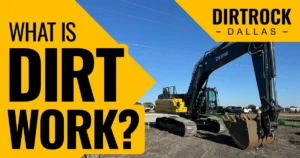
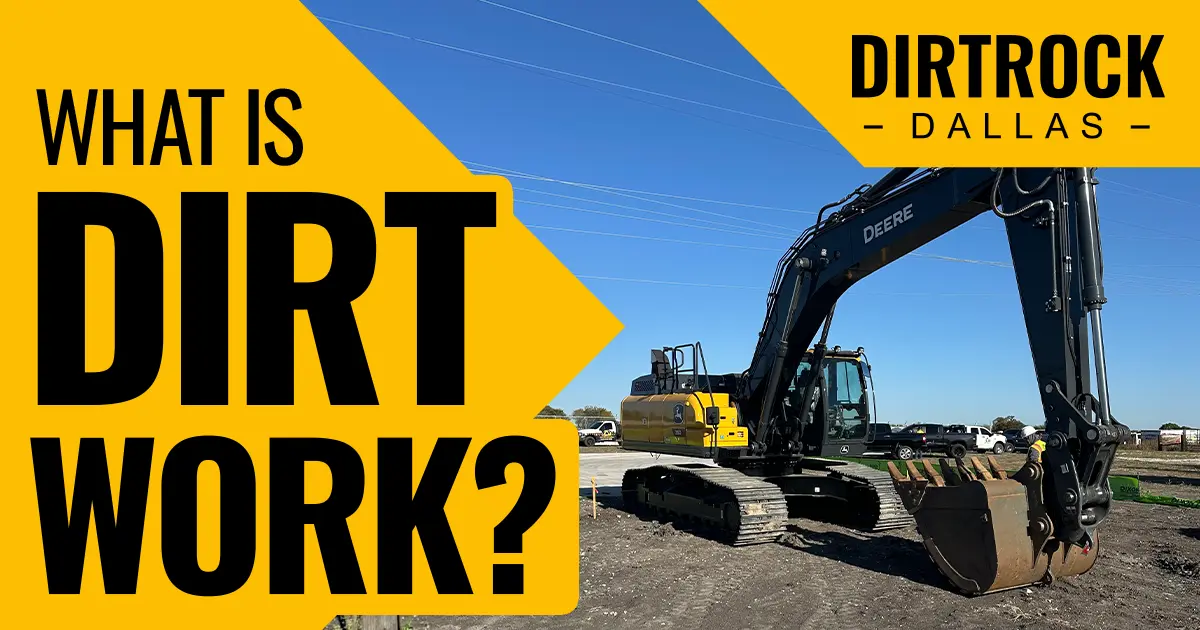
Dirt work is any construction activity that involves moving, removing, or reshaping earth on a job site. That includes digging foundations, leveling land, clearing trees and brush, building drainage slopes, and hauling material on or off the property. If heavy equipment is pushing dirt around, it falls under dirt work.
Most people search for “excavation” when they need this kind of work done. The industry uses both terms, and they overlap almost completely. The difference is mostly regional. In Texas, you’ll hear “dirt work” on residential and agricultural jobs more than you’ll hear “excavation,” which tends to show up in commercial bid documents.
What services fall under dirt work?
Dirt work is an umbrella term. It covers at least six distinct services, and most projects need more than one.
Excavation
Excavation is the core of dirt work. It means removing earth to create a hole, trench, or cut for a specific purpose: a foundation, a utility line, a pond, a swimming pool, a storm drain. The scope can range from a 4-foot trench for a residential water line to a 20,000-cubic-yard commercial foundation dig.
Equipment depends on the job. A residential utility trench might need a mini excavator. A large commercial cut needs a full-size excavator paired with articulated dump trucks to haul the spoil.
Grading and drainage
Grading is the process of shaping the land surface to control how water moves. Every building permit in DFW requires a drainage plan, and grading is how you execute it. The goal is to direct rainwater away from structures and toward designated drainage points without flooding your neighbor’s yard.
This matters more than most homeowners realize. North Texas gets 35-40 inches of rain per year, much of it in spring downpours. If the grade around your foundation pushes water toward the house instead of away from it, you’ll be dealing with foundation issues within a few years. Black clay soils in DFW expand and contract with moisture, which makes proper grading even more important here than in other parts of the state.
Site preparation and land clearing
Site preparation is the work that happens before construction starts. It includes clearing trees, brush, and debris, stripping topsoil, rough grading the pad, and establishing access roads. On raw land in areas like Forney, Royse City, or Terrell, site prep can be the biggest single line item before vertical construction begins.
We wrote a full guide on how to clear land for a house if you want the step-by-step breakdown.
Demolition
Demolition falls under dirt work when it involves tearing down structures to clear a site for new construction or regrading. That could mean taking out an old concrete driveway, removing a foundation, or leveling a small outbuilding. The debris has to go somewhere, which ties demolition directly to hauling.
Not all demolition contractors handle dirt work, and not all dirt work contractors handle demolition. Working with a company that does both saves you from coordinating two separate crews and two separate schedules.
Hauling
Hauling is the transportation side of dirt work. Every excavation produces material that needs to go somewhere, and every fill job needs material brought in. Hauling covers both directions: exporting spoil, rock, or demolition debris to a dump site, and importing fill dirt, topsoil, gravel, or base material.
The cost of hauling depends heavily on distance. A dump site 5 miles from the job is a different number than one 25 miles away. In DFW, landfill and dump fees vary by municipality, and some materials (like concrete rubble) can go to recycling facilities instead.
Concrete removal and replacement
Concrete work overlaps with dirt work more than people expect. Removing an old driveway, sidewalk, or patio is a demolition and hauling job. Pouring a new one requires a properly graded and compacted subbase, which is a dirt work job. If you’re replacing a concrete driveway in Texas, the contractor handling your dirt work and the one pouring your concrete need to be coordinated, or ideally the same company.
What affects the price of a dirt work project?
The spread between the low and high end of those ranges comes down to a few specific factors.
Soil conditions are the biggest variable in North Texas. The western half of the DFW metroplex sits on limestone and caliche. The eastern half (Rockwall, Forney, Terrell) is a mix of black clay and sandy loam with pockets of rock. Hitting solid rock during excavation slows production and wears equipment faster. On a residential foundation dig, rocky soil can add 30-50% to the excavation line item compared to the same job in clean sandy soil.
Job size and access matter more than most people think. A small residential lot with tight access (narrow driveway, fences, overhead power lines) limits the equipment you can bring in. Smaller equipment means slower production and higher per-unit costs. Wide-open commercial sites with easy truck access are faster and cheaper per yard.
Haul distance is a pure math problem. Every mile between your site and the dump (or the material source) adds fuel, time, and truck wear. If you’re on the outskirts of the metroplex, ask where the hauling is going.
Permits and regulations vary by city. Dallas, Rockwall, Garland, and Mesquite all have different requirements for grading permits, erosion control, and stormwater management. Some municipalities require engineered plans for any grading that changes drainage patterns. That engineering cost isn’t part of the dirt work bid, but it affects your total project budget.
Demolition scope can change the math fast. If an old slab, driveway, or structure needs to come out before the dirt work starts, that’s a separate operation with its own equipment, labor, and disposal costs layered on top.
How to hire a dirt work contractor in DFW
Finding a contractor who answers the phone isn’t the hard part. Finding one who shows up, does quality work, and doesn’t leave you with drainage problems two years later takes more diligence.
Start with insurance. Any contractor working on your property should carry general liability insurance ($1M minimum) and workers’ compensation. Ask for the certificate of insurance, not just a verbal confirmation. If they don’t have workers’ comp coverage, you could be liable for injuries on your property.
Check whether they own their equipment or rent it. Companies that own their fleet have more control over scheduling and availability. If a contractor is renting equipment for your job, delays from the rental company become your delays.
Ask about their experience with your specific project type. A contractor who does commercial site prep all day might not be the right fit for a backyard pond. The equipment is different, the approach is different, and the margin for error on a residential lot is smaller because mistakes are closer to your house.
Get at least three bids, but don’t default to the cheapest one. The low bid often means the contractor underestimated the scope, and you’ll pay for it in change orders. Look for the bid that most clearly describes the work, the equipment, and the timeline.
DIY vs. hiring a contractor
Small jobs can be DIY. If you’re spreading a few yards of topsoil in your backyard or leveling a small area for a shed pad, a rented skid steer and a weekend might get it done.
Anything beyond that needs a contractor. Grading for drainage requires a laser level and an understanding of how water moves across the site. Excavation near utilities requires locate services and experience reading utility maps. Any work that changes the grade near your property line can create liability issues with neighbors and the city.
Permit requirements are the bright line. If your city requires a grading permit for the scope of work you’re planning, hire a contractor who has done permitted work in that jurisdiction before.
Frequently asked questions
How long does a dirt work project take?
Most residential dirt work projects in DFW take one to five days of active equipment time. A simple lot grading might finish in a day. A full site prep with clearing, grading, and hauling on a half-acre lot typically runs three to five days. Weather can extend any timeline, especially during spring storm season in North Texas.
Do I need a permit for dirt work in Dallas?
It depends on the scope. Dallas requires a grading permit for any work that changes drainage patterns or moves more than a certain volume of earth. Smaller jobs like driveway base prep typically don’t require a permit. Your contractor should know the permit requirements for the specific city where your project is located.
What equipment is used for dirt work?
The most common machines on a dirt work job are excavators, bulldozers, skid steers, and dump trucks. Excavators handle digging and loading. Dozers push and spread material. Skid steers work in tight spaces and handle finish grading. Dump trucks move material on and off site. The specific equipment depends on the job size and access conditions.
What’s the difference between dirt work and excavation?
Practically, they’re the same thing. “Excavation” refers specifically to digging and removing earth, while “dirt work” is the broader term that includes grading, land clearing, hauling, and site preparation in addition to excavation. Most contractors in DFW use the terms interchangeably.
Can one contractor handle excavation, grading, and concrete?
Some can, and it’s worth looking for one that does. Using a single contractor for earthwork and concrete means one crew is responsible for the subgrade preparation and the finished surface. If the concrete cracks because the base wasn’t compacted properly, there’s no finger-pointing between two separate contractors. DirtRock Dallas handles excavation, grading, demolition, and concrete with in-house crews.
Get a dirt work estimate for your DFW project
If you have a residential or commercial project that needs dirt work in the Dallas-Fort Worth area, get in touch for a site visit and estimate. We’ll walk the property, talk through the scope, and give you a number based on what’s actually there, not a guess from Google Maps.
DirtRock Dallas is a veteran-owned, fully insured excavation contractor based in Rockwall, TX. We carry $1M in general liability, $2M aggregate, and $1M in workers’ compensation coverage.