
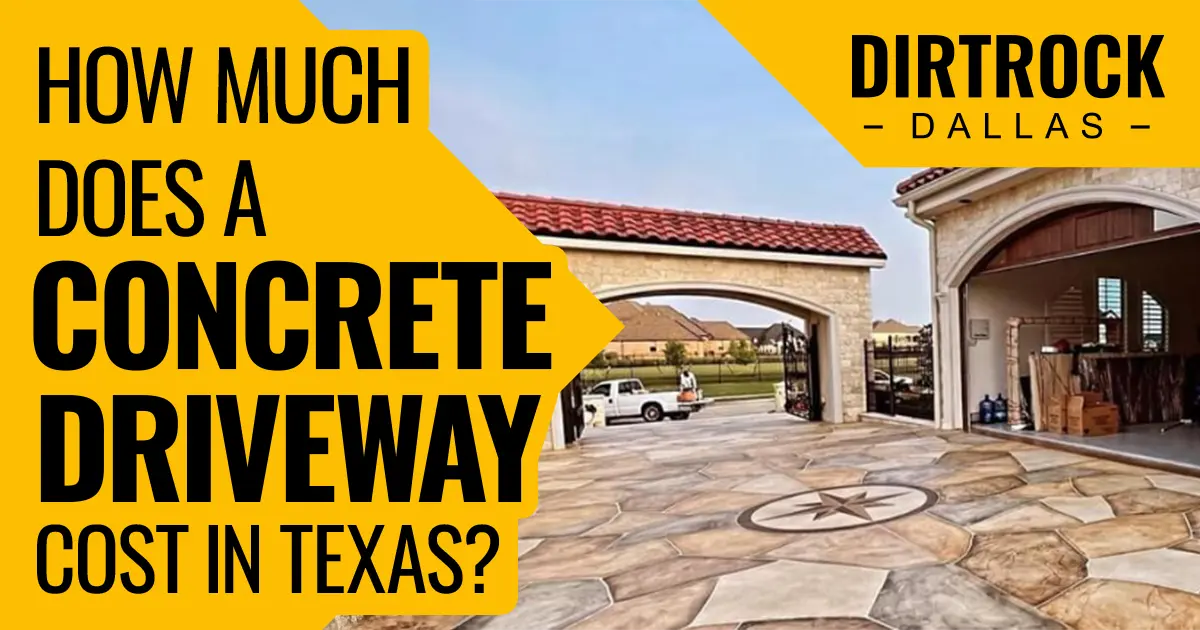
If you’ve searched “how much does a concrete driveway cost” and landed on a page full of national averages, you already know the problem. Those numbers come from data sets that lump Ohio, Oregon, and Texas into one average. Material prices, labor rates, and soil conditions in Dallas-Fort Worth don’t track with what a homeowner in Portland deals with. A $12/sqft average from a national site won’t tell you what your driveway will actually cost in Rockwall or Frisco.
This guide uses real DFW pricing broken down by square foot, finish level, and driveway size. Use it to compare quotes with actual numbers instead of guessing.
What a Concrete Driveway Costs in the Dallas–Fort Worth Area
Most contractors in North Texas will quote somewhere between $7 and $21 per square foot. That range covers three tiers.
Standard Poured Concrete: $7–$10/sqft
Plain or broom-finish slab. Four inches of concrete over rebar reinforcement with basic site prep. You can add a tint if you want color. A standard two-car driveway runs about 600 square feet, so expect $4,200 to $6,000 installed.
Stamped or Decorative Concrete: $10–$15/sqft
This is where you start to get curb appeal without the full premium price tag. Single-color stamping or texturing in patterns like wood plank or slate, sealed after the pour. Thickness goes up to 4 or 5 inches with rebar. For a 600-sqft two-car driveway, that puts you at $6,000 to $9,000.
Premium Stamped Concrete: $15–$21/sqft
Multi-color stamping (flagstone, cobblestone), integral color pigments mixed into the concrete itself, and a double-seal finish that resists UV fading. Six inches thick with a full rebar grid. At 600 square feet, budget $9,000 to $12,600. This tier is built for homeowners who want the driveway to match a high-end property.
Quick Cost Reference by Driveway Size
| Driveway Type | Typical Size | Standard ($7–$10) | Stamped ($10–$15) | Premium ($15–$21) |
|---|---|---|---|---|
| Single-car (10ft × 30–50ft) | 400 sqft | $2,800–$4,000 | $4,000–$6,000 | $6,000–$8,400 |
| Two-car (20ft × 30–40ft) | 600 sqft | $4,200–$6,000 | $6,000–$9,000 | $9,000–$12,600 |
| Large / turnaround / RV pad | 1,000 sqft | $7,000–$10,000 | $10,000–$15,000 | $15,000–$21,000 |
DFW lots tend to run larger than the national average. Texas households usually park more vehicles, too. Most two-car driveways we pour in the Metroplex fall between 600 and 800 sqft.
Why Two Quotes Can Be $14/sqft Apart (and Both Be Legit)
You get two bids. One says $7 per square foot. The other says $21. Don’t assume the second contractor padded the invoice. The gap almost always comes down to what’s included in each bid.
The concrete itself is rarely what separates a cheap quote from an expensive one. What drives the price is everything that happens before the pour and how thick the slab ends up.
Thickness
This is the single biggest factor that determines whether a driveway lasts or cracks within five years. Standard residential pours in DFW run 4 inches for passenger vehicles. But 4 inches isn’t always enough.
A large percentage of North Texas sits on expansive clay soil. That soil swells when it rains and shrinks when it dries. If your lot has clay, you need 5 to 6 inches to handle the seasonal ground movement. Same story if you plan to park heavy trucks, trailers, an RV, or a boat on it. The extra concrete adds cost, but it also changes what you need for reinforcement and subgrade prep underneath.
One more thing to check on any quote: the PSI rating. Most residential pours around here use 3,500 to 4,000 PSI mix. Anything below 3,000 PSI is underspec for vehicle traffic. If a quote doesn’t list the PSI, ask. It matters.
Subgrade Prep and Soil
The concrete is only as good as the ground underneath it. Expansive clay soils swell when wet, shrink when dry. Skip proper subgrade compaction and drainage, and even a thick slab will shift and crack within a few years.
Professional subgrade prep means removing topsoil, compacting the base with heavy equipment, and laying a gravel or limestone base layer before any concrete goes down. Contractors who own commercial-grade rollers and motor graders get better compaction results than a crew that does everything by hand with a plate tamper. That difference shows up years later when the slab either stays flat or doesn’t.
What Else Affects the Price
If you need to tear out an existing driveway before the new pour, that adds $2 to $4 per square foot for demo and haul-off.
Drainage grading is another one. The finished driveway needs to slope away from your garage and foundation. Proper finish grading prevents this. Get the slope wrong and you end up with water pooling against the house. That creates foundation problems that cost far more than the driveway ever did.
Reinforcement type matters too. Rebar grid gives you structural tensile strength across the entire slab. Fiber mesh is cheaper but doesn’t deliver the same structural support. For driveways, rebar is the standard. If a quote only lists fiber mesh, ask why they went that route.
Dallas requires a permit for new pours and full replacements. Factor that into your budget and timeline.
Tight lots or steep grades add labor. If the concrete truck can’t back straight up to the pour site, the crew has to pump the concrete in, and that costs more.
How Long Does a Concrete Driveway Last?
A properly installed concrete driveway lasts 25 to 30 years in this climate. Some go longer if you seal them every few years. Asphalt needs resurfacing every 12 to 20 years by comparison.
“Properly installed” is doing a lot of work in that sentence. A thin pour with no rebar and sloppy subgrade work might save $2,000 upfront. But you’ll spend $8,000 on tear-out and replacement inside of a decade. You pay for the job once, or you pay for it twice.
Contractor selection is where this plays out. A crew that uses commercial-grade compaction equipment on a residential pour delivers the same subgrade density you’d find under a commercial parking lot. The slab sits flat and stays flat through 100-degree summers, freeze-thaw cycles, and all the clay soil movement North Texas likes to throw at it.
Should You DIY a Concrete Driveway?
Fair question when you see those price tags. The short answer is probably not, at least for a full driveway.
A DIY pour is technically possible if you have construction experience, access to a concrete mixer or pump truck, and enough people to finish 600-plus square feet of wet concrete before it sets. In Texas summer heat, that window is about 90 minutes. It goes fast.
Subgrade prep is the first problem. Hand-tamping 600 square feet doesn’t achieve the compaction density you need to prevent settling. You can rent a plate compactor from Home Depot, but it still won’t match what a ride-on roller does.
The second problem is timing. Once the truck arrives, the clock starts. A professional crew has enough people to screed, bull float, edge, and finish the surface before it dries. Two people working a two-car driveway will almost certainly end up with inconsistent finish, cold joints, or surface defects. Concrete doesn’t give you a second chance.
And if you get the grading or slope wrong, you tear it all out and start over at full cost. There’s no patching a bad pour.
Small pads or walkways? DIY can work fine for those. A full driveway is a different animal.
How to Compare Concrete Driveway Quotes in DFW
A $4,500 quote and a $7,000 quote can describe completely different jobs. The gap usually isn’t about one contractor overcharging. It’s about what each bid includes and what it leaves out. Before you sign anything, read every line item and confirm the following.
The bid should list slab thickness (4″, 5″, or 6″), PSI rating (3,500 or higher for driveways), and reinforcement type. Rebar grid is the standard for driveways in DFW. If a quote lists fiber mesh only, ask why.
Subgrade prep is another line item that separates a thorough bid from a cheap one. Grading, compaction, and a base layer all need to appear. Some bids assume the ground is already prepped. That assumption can add $1,000 or more in surprise costs once the crew shows up and sees what they’re actually working with.
The finished driveway also has to slope away from your garage and foundation. Water that pools against the house creates foundation problems that cost far more than the driveway itself. If the bid doesn’t mention drainage grading, ask how they plan to handle runoff.
If you’re replacing an existing surface, demo and disposal should show up as a separate line item. Some contractors leave removal out to make the bid look lower, then add it back as a change order after you’ve signed.
Dallas requires a permit for new pours and full replacements. Confirm whether the contractor pulls it or expects you to handle it yourself. Also check whether the price includes sealant, how many coats, and whether it’s UV-resistant. Your driveway will sit in direct Texas sun eight months out of the year. That matters.
One more thing: Dallas code sets a minimum driveway width of 10 feet and a maximum of 30 feet at the property line. Single-car driveways typically run 10 to 12 feet wide. Go with 12 if you can. Half the vehicles in Texas are trucks or SUVs. Two-car driveways usually land between 20 and 24 feet.
A contractor who puts all of this on paper before you ask for it pours driveways every week. That’s who you want quoting your job.
Get a Straight Answer on Your Driveway
As a full-service concrete contractor in Dallas-Fort Worth, DirtRock Dallas quotes every project with full line-item transparency. Thickness, PSI, reinforcement, subgrade prep, drainage, finish. It’s all on paper before work starts. We use commercial-grade compaction equipment on every residential job because the ground doesn’t care whether the slab goes in front of a house or a warehouse. It needs the same density either way.
Request a free driveway estimate from DirtRock Dallas →
Frequently Asked Questions
How much does it cost to replace a concrete driveway?
Replacement includes the cost of demo and haul-off for the existing surface (typically $2 to $4/sqft) on top of the new pour. For a 600-sqft two-car driveway in DFW, budget an additional $1,200 to $2,400 above the per-square-foot pricing listed in the table.
How thick should a concrete driveway be?
Four inches works for passenger vehicles on stable soil. In North Texas, expansive clay is common enough that 5 to 6 inches with rebar reinforcement is the safer call. Go with the thicker pour if you park trucks, trailers, or anything heavier than a sedan on it daily.
How long does a concrete driveway last?
Expect 25 to 30 years from a well-installed pour in the Texas climate. How close you get to 30 depends on subgrade compaction, slab thickness, rebar reinforcement, and whether you reseal the surface every few years.
Is stamped concrete worth the extra cost?
Stamped concrete runs $3 to $11 more per square foot than standard broom-finish. You’re paying for curb appeal. For homeowners who care about how the front of the house looks (for personal satisfaction or resale value), the upgrade tends to pay for itself.
What’s the difference between rebar and fiber mesh?
Rebar is a steel grid that gives the slab structural tensile strength. Fiber mesh is synthetic fibers mixed into the concrete that reduce surface cracking but don’t provide the same load-bearing reinforcement. For driveways, rebar is the standard. Fiber mesh alone won’t do the job.